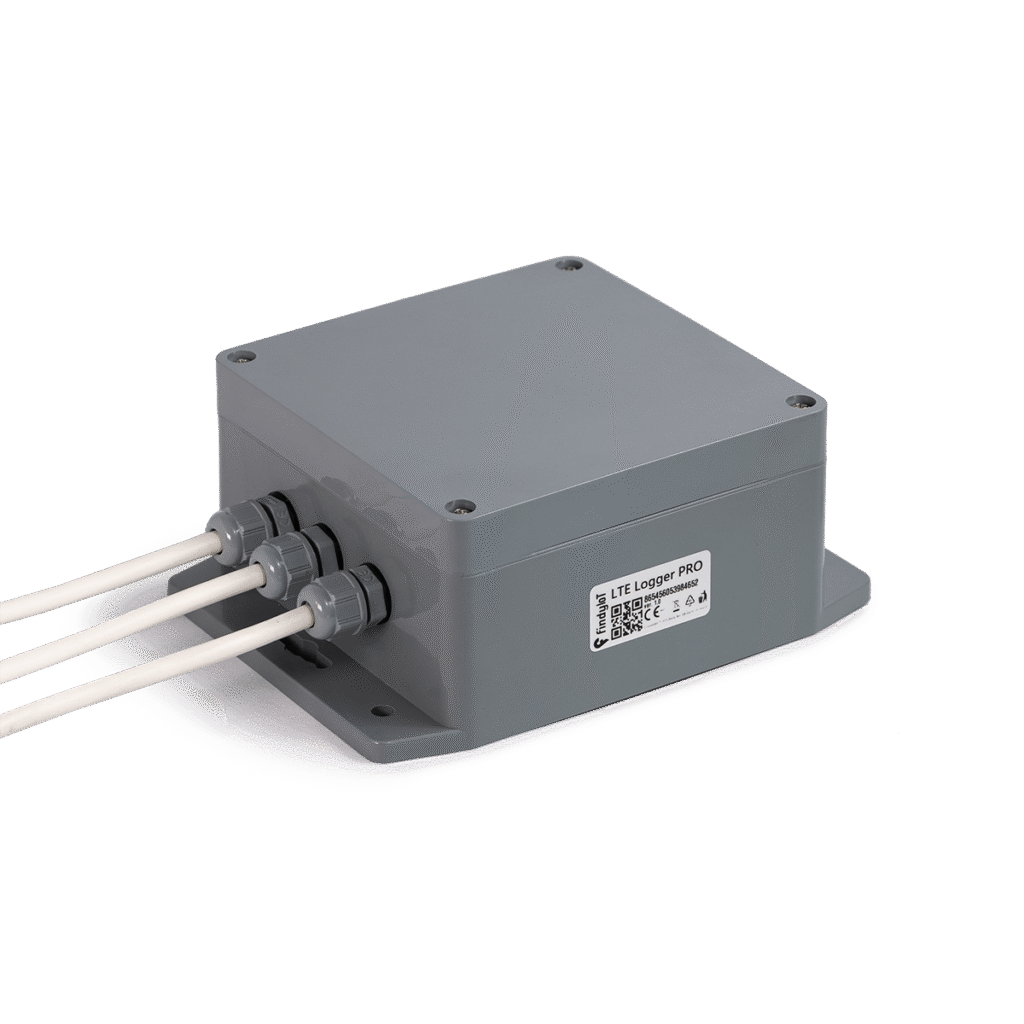
LTE Logger Pro
The flagship findy Lab device — full industrial I/O, LTE Cat 1 bis with 2G fallback, programmable in MicroPython.
| Qty | 1 pc | 10–99 | 100–499 | 500+ |
|---|---|---|---|---|
| Price | €166.00 | €124.50 | €99.60 | €83.00 |
+ €25 / device / year — findy IoT Platform, global LTE SIM, OTA updates, support.
Everything below is wired on the V.12 board and, unless marked, has a findy Lab API today. Colour indicates type.
3.5 mm pitch, three positions per block, as wired on the V.12 board. Top row left to right, then bottom row.
J1
External supply| 1 | GND | |
| 2 | GND | |
| 3 | +V Ext | 6–30 V DC input · solar panel or DC supply |
J4
Analog| 1 | +3.3 V out | Peripheral rail |
| 2 | GND | |
| 3 | Analog IN | 0–5 V · ID 582 |
J7
Channel 1| 1 | Digital / pulse IN 1 | ULP counted · ID 437 |
| 2 | 4-20 mA #1 −Load | Low side of the shunt |
| 3 | 4-20 mA #1 +Load | Loop return · ID 520 |
J10
Channel 2| 1 | Digital / pulse IN 2 | ULP counted · ID 439 |
| 2 | 4-20 mA #2 −Load | Low side of the shunt |
| 3 | 4-20 mA #2 +Load | Loop return · ID 570 |
J13
Relay 2| 1 | Relay 2 | Contact |
| 2 | Relay 2 | Contact |
| 3 | Relay 2 | Contact |
J16
Relay 1| 1 | Relay 1 | Contact |
| 2 | Relay 1 | Contact |
| 3 | Relay 1 | Contact |
J19
Sensor supply| 1 | +24 V out | Behind a 0.2 A polyfuse |
| 2 | GND | |
| 3 | +12 V out |
J24
RS485| 1 | RS485 A / B | Half-duplex · API coming |
| 2 | GND | |
| 3 | RS485 A / B | 120 Ω termination on board |
J22
1-Wire| 1 | 1-Wire data | 4.7 kΩ pull-up · API coming |
| 2 | GND | |
| 3 | +3.3 V | Dedicated 1-Wire rail |
J8 · J9 · J11 · J12
Ground| 1–3 | GND | Twelve ground positions for sensor returns |
measure() when parameter 640 is set, so they double as switched sensor rails. Contact rating: see the datasheet supplied with the device.measure() with MicroPython.Enclosure, battery and pricing as published on findyiot.com; terminals, rails and processor figures read from the V.12 schematic; firmware behaviour from the findy Lab documentation.
boot.py and firmware_core.mpy stay as shipped. You edit last.py: what the device measures, what it reports, and how long it sleeps.
datalist = ['582', '290', '421', '443']   # what this device reports

def start(self):
    self.measure()
    self.report(False, datalist)          # alarm=False
    self.prepareSleep(int(core.db.read('421')), True)

fw.start = start
# Loop current arrives as mA on ADC channel 1.
# Scaling limits 553–556 (AIN1) and 578–581 (AIN2) are set in the platform.
ina1 = round(self.adcMeasure(b'') / 100, 2) # mA
sensor_min = float(core.db.read('553')) # 4 mA
sensor_max = float(core.db.read('554')) # 20 mA
qty_min = float(core.db.read('555')) # 0 bar
qty_max = float(core.db.read('556')) # 10 bar
qty = (ina1 - sensor_min) * ((qty_max - qty_min) /
(sensor_max - sensor_min))relay12 = machine.Pin(relay12V, machine.Pin.OUT)
relay5 = machine.Pin(relay5V, machine.Pin.OUT)
machine.Pin(PperipherialPower, machine.Pin.OUT).value(1)
if core.db.read('640') == b'1':
relay12.value(1)
relay5.value(1)
time.sleep(int(core.db.read('587'))) # sensor warm-up
# ... read the ADC channels ...
relay12.value(0)
relay5.value(0)
machine.Pin(PperipherialPower, machine.Pin.OUT).value(0)counter.initCounter() # once — loads ulp_main.bin, starts the ULP program
counter.getSamplings() # each wakeup — deltas into 437/439 + ring-buffers 540/541
# A custom parameter of your own:
databaseParams["900"] = ["W", 0, 0, 0, "0", "W"]
core.db.read('900') # read it — add '900' to datalist to report itEvery card below is a system parameter the framework fills in. The loop value is scaled to your engineering unit by the limits you enter in Settings — no code.
4-20 mA · pulse · 0–5 V sensors
Switched rails, warm-up, ULP counting in sleep
LTE Logger Pro
Your measure() runs here — MicroPython v1.25
LTE Cat 1 bis / 2G
Global findy SIM, embedded
findy IoT Platform
Measurements, settings, commands — by parameter ID
Your system
API, webhooks, export
Each one runs on the shipped firmware — no RS485 or 1-Wire until the drivers land.
Ready-made solutions
Complete deployments built on Logger Pro — metering, level and pressure monitoring, environmental sensing — delivered and supported end to end.
View solutionsHave your own system?
We supply the logger and the SIM. You take the data from the platform API into the infrastructure you already run.
Talk to our team →Write your own logic
You're here. Wire the terminals, edit one file, deploy the next version over the air.
Can't do it? Enterprise team →